By the EGY Herb Export team. Updated October 2026.
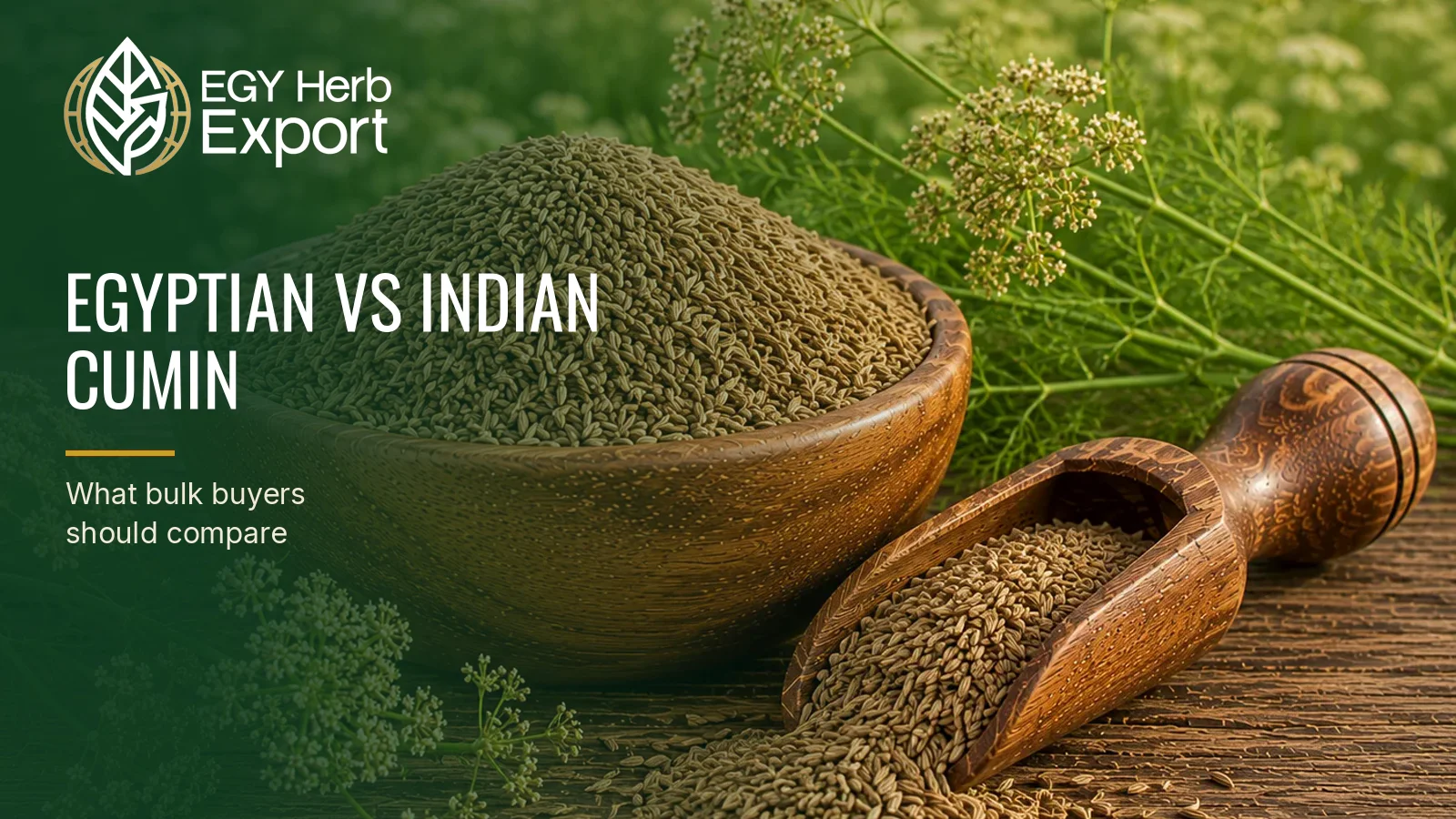
Short answer: neither origin wins every time. India is the biggest cumin producer and sets the reference grades. Egypt is a smaller supplier with a shorter sea route to the Gulf, the Mediterranean and Europe. What decides quality is the specification of the lot you are buying: purity, volatile oil, foreign matter and moisture. Get those in writing, test a sample, then compare landed cost.
| What to compare | What to ask for | Figures you will see |
|---|---|---|
| Purity | Cleaning method and a minimum percentage | 99% and above for machine-cleaned or Sortex-cleaned cumin |
| Volatile oil | Minimum, with the unit and test method | Indian spec sheets list about 2 to 4%. Ours is a minimum of 2 ml per 100 g |
| Foreign matter | Maximum percentage | About 0.5 to 1% depending on grade |
| Moisture | Maximum percentage | About 10% |
| Crop year | Year and growing region | Differs between origins |
Is Egyptian cumin better than Indian cumin?
Not as a rule. A clean Egyptian lot beats a dirty Indian one, and the other way round. India grows and consumes more cumin than anyone, so many buyers use Indian cumin as their benchmark. Egyptian cumin comes from Upper Egypt, including Beni Suef, and is sold as whole seed (machine-cleaned or Sortex-cleaned) and as ground powder. Its practical advantage is distance. A shipment from Cairo reaches Jeddah, Marseille or Hamburg faster than one from Mundra, and that matters if you buy on short notice.What do the Indian grade names mean?
You will see "Singapore" and "Europe" grade on Indian offers. On the supplier sheets we looked at, the difference is mostly the allowed foreign matter, with the Europe grade stricter. Grade names are a sales label, not a standard. Ask any supplier, Indian or Egyptian, to write the limits as numbers.How can I check a cumin sample myself?
You don't need a lab for a first look.- Pour a handful onto white paper. Stems, stones and dust show up immediately.
- Rub a pinch between your palms and smell it. Fresh cumin is strong and warm. A flat or dusty smell means old stock.
- Look at the color. Even light brown is good. Dark or mixed seeds point to weather damage or poor sorting.
- Sieve a sample and weigh what falls through. That is your broken seed and dust.
What should I ask every supplier?
- Machine-cleaned or Sortex-cleaned?
- Minimum purity, minimum volatile oil and maximum foreign matter, as numbers.
- Which crop year, and from where?
- A certificate of analysis for the actual lot, plus the phytosanitary certificate and a residue report.
- Packing, how much fits in a container, and lead time.