By the EGY Herb Export team. Updated October 2026.
Short answer: "quality" in herb export means numbers on a certificate of analysis: moisture, essential oil, impurities, microbiology and pesticide residues, plus the certificates your market requires. Write those numbers into the purchase contract and check them on the lot you receive.
| Parameter | Typical requirement | Why it matters |
|---|---|---|
| Moisture | Usually 10 to 12% at most for dried herbs | Wet product molds and clumps in transit. It is the most common reason for complaints |
| Essential oil | Stated as a minimum, for example 0.4 to 1.5% v/w for our chamomile | Aroma and strength, and a direct factor in price |
| Impurities | About 1% at most | Stems, leaves, dust and foreign matter |
| Pesticide residues | Below your market's limits | Over-limit shipments can be rejected at the border |
| Microbiology | Total plate count, E. coli, Salmonella, yeast and mold | Food safety, required by most EU buyers |
| Color and grade | Defined per product | Hibiscus is judged on color, chamomile on whole flowers |
What moisture should dried herbs have?
Most dried herbs are specified at about 10 to 12% moisture at most, and some pharmaceutical or extraction buyers ask for less. Higher moisture speeds up microbial growth in transit and shortens shelf life. Egypt's dry weather during harvest makes it easier to reach the target by sun drying, but you should still confirm the number on the certificate.How do buyers compare essential oil content?
For aromatic herbs, essential oil is a main quality indicator. Our chamomile is specified at 0.4 to 1.5% v/w. Check the unit and the test method before comparing two suppliers, and ask for results from more than one season so you know the figure is consistent and not a single good batch. The same applies to mint and basil.What about pesticide residues?
The EU sets maximum residue levels for pesticides in herbs and spices under Regulation (EC) No 396/2005, and other markets have their own limits. A supplier's declaration is not enough. Ask for a multi-residue pesticide panel from an accredited laboratory, linked to your lot, and compare it with the limits of your destination market.Which microbiology tests are standard?
Total plate count, E. coli, Salmonella and yeast and mold counts are common in food and pharmaceutical supply chains. Dry weather helps keep mold down, but storage between drying and loading matters just as much, so ask how the product is stored.How is color and grade judged?
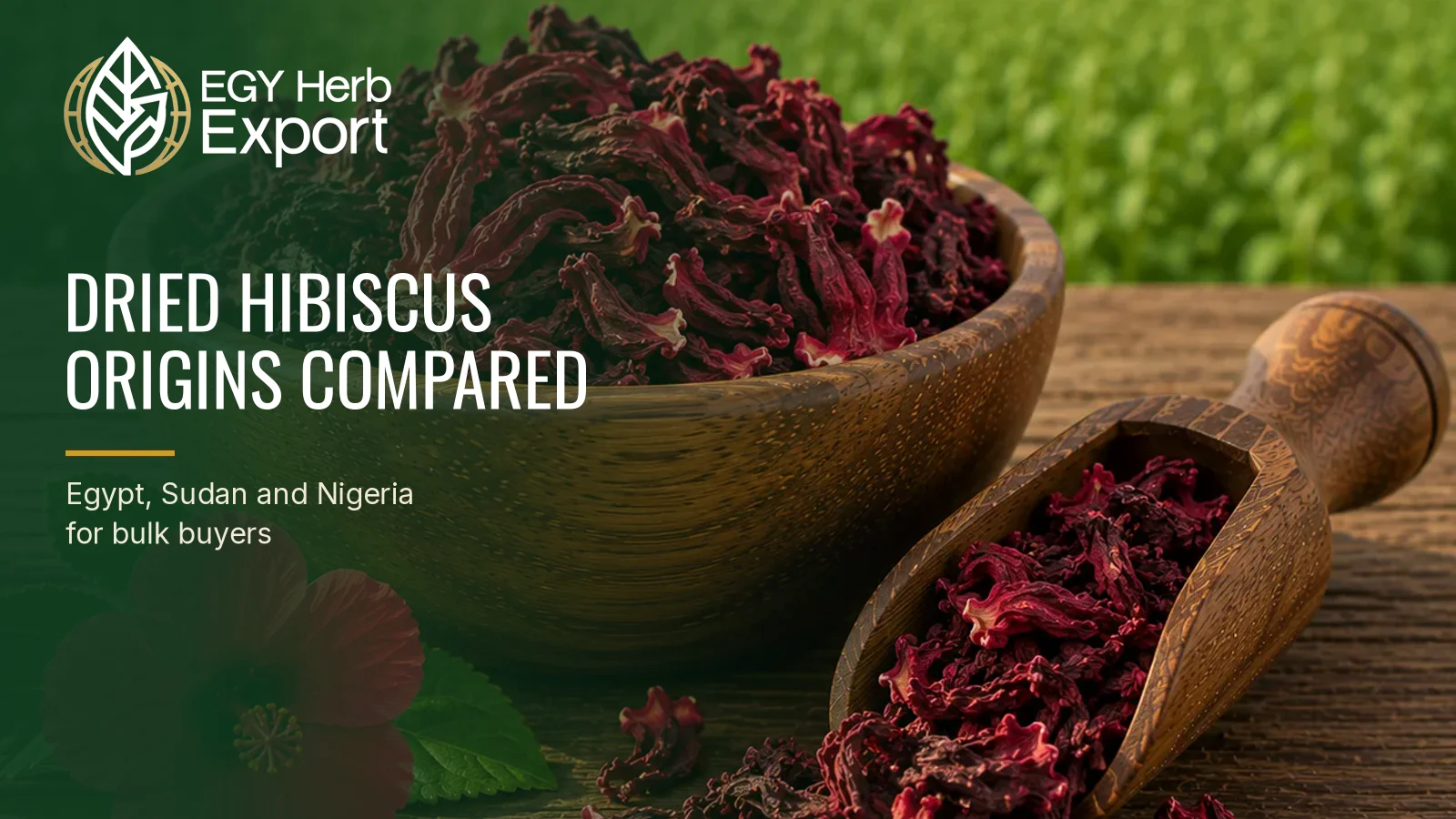
For hibiscus, color is a commercial specification: deep red indicates higher anthocyanin content and gives better-looking drinks. For chamomile, buyers specify head size, the share of whole flowers against broken and the amount of stem. Premium pharmaceutical grade is whole flower heads with little or no stem. Tea grade allows more broken flowers. See chamomile grades for detail.Which certificates affect market access?
- EU organic: required to sell as organic in the EU, under Regulation (EU) 2018/848. Certification applies at farm level, so ask for the farm certificate too.
- USDA Organic: required for organic claims in the United States.
- ISO 22000 or FSSC 22000: food safety management, often required by food manufacturers when approving a supplier. We hold ISO certification.
- HACCP: a standard food safety system in professional processing.
- Halal: usually required for the Gulf.
What separates a reliable supplier from an unreliable one?
- It can trace the product to named farms and regions, not just "Egypt".
- It works with accredited laboratories and tests before shipment, not after.
- It stores the product in clean, dry conditions between processing and loading.
- It issues the full document set with every shipment: certificate of analysis, phytosanitary certificate, certificate of origin and a pesticide report where needed.