By the EGY Herb Export team. Updated October 2026.
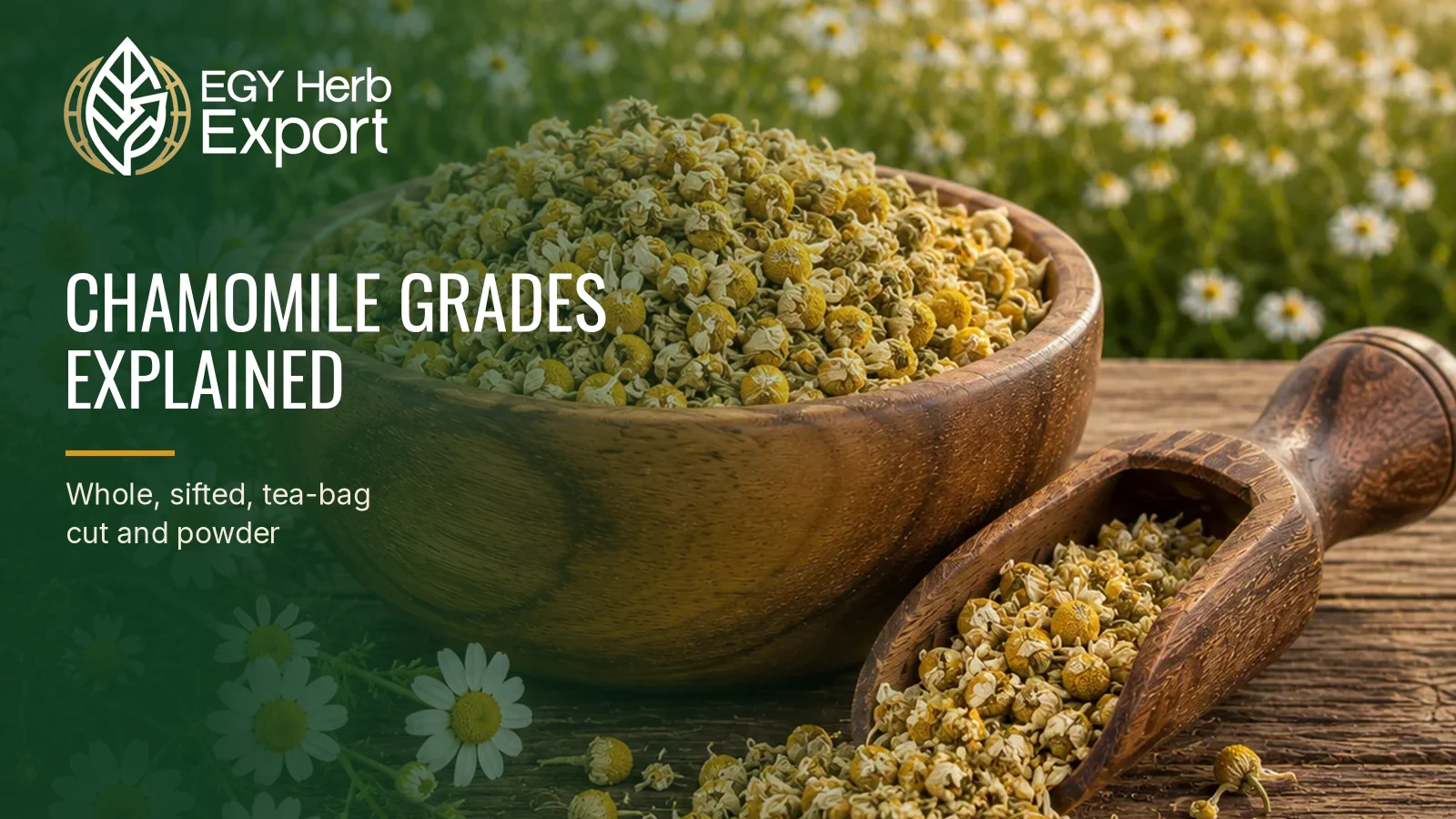
Short answer: dried chamomile is sold in four forms: whole flower heads, sifted flowers, broken or tea-bag cut, and powder. Whole flowers cost the most and suit premium tea and pharmaceutical use. Broken grade is the standard for tea bags. Powder goes into extracts, supplements and cosmetics. Pick the form first, then write the specification: moisture, essential oil, impurities and, for whole flowers, the share of intact heads.
| Grade | What it is | Typical use |
|---|---|---|
| Whole flower heads | Intact dried heads, stems kept to a minimum | Premium loose tea, gift packs, pharmaceutical use |
| Sifted flowers | Whole flowers with stems, leaf bits and dust sieved out | Higher-end tea blends |
| Broken or tea-bag cut | Broken or cut to a set particle size | Tea bags and standard blends |
| Milled powder | Ground to a stated mesh size | Extracts, supplements, cosmetics, flavoring |
What is the difference between whole and sifted chamomile?
Whole chamomile is the complete dried flower head. Sifted chamomile is the same flower after the stems, leaf fragments and dust have been sieved out, so it looks cleaner. If you buy either, ask what share of whole heads the lot contains and write that minimum into the contract. A bag of "whole" flowers that is half broken is a common complaint.What is tea-bag cut chamomile?
It is chamomile broken or cut to a defined particle size so it fills tea bags evenly. Tell your supplier the size in millimeters that suits your filling machine. Powder needs the same care: state the mesh size, and ask about microbiological limits, because fine powder is more exposed to contamination.What should a chamomile specification include?
- Share of whole heads for whole and sifted grades.
- Color. Bright yellow centers and creamy petals mean a fresh, well-dried crop. Browning means age or damp storage.
- Moisture, usually 10% at most.
- Essential oil. Trade sources quote roughly 0.3 to 1.5% for dried flowers. Ours is specified at 0.4 to 1.5% v/w. Check the unit and the test method before you compare two suppliers.
- Impurities such as stems, leaves and dust, usually limited to about 1%.
- Active compounds. If your product makes claims based on apigenin or bisabolol, ask whether the supplier tests for them. Many standard certificates don't include them.
- Safety tests. Total aerobic count, E. coli, Salmonella and a multi-residue pesticide panel against your market's limits.
How do I judge a chamomile sample?
- Look at it dry: color, how many heads are whole, how much stem and dust there is.
- Smell it. Fresh chamomile smells sweet, a bit like apple. A flat or musty smell points to old or damp stock.
- Brew it next to your reference and compare the cup.
- Read the certificate for moisture, essential oil, impurities, microbiology and pesticides, and check that it belongs to the same lot as the sample.