The Environment Question Every Serious Buyer Asks
When procurement teams evaluate herb suppliers across multiple countries, one question comes up consistently: why does origin matter if the species is the same? A chamomile flower is a chamomile flower, regardless of where it was grown.
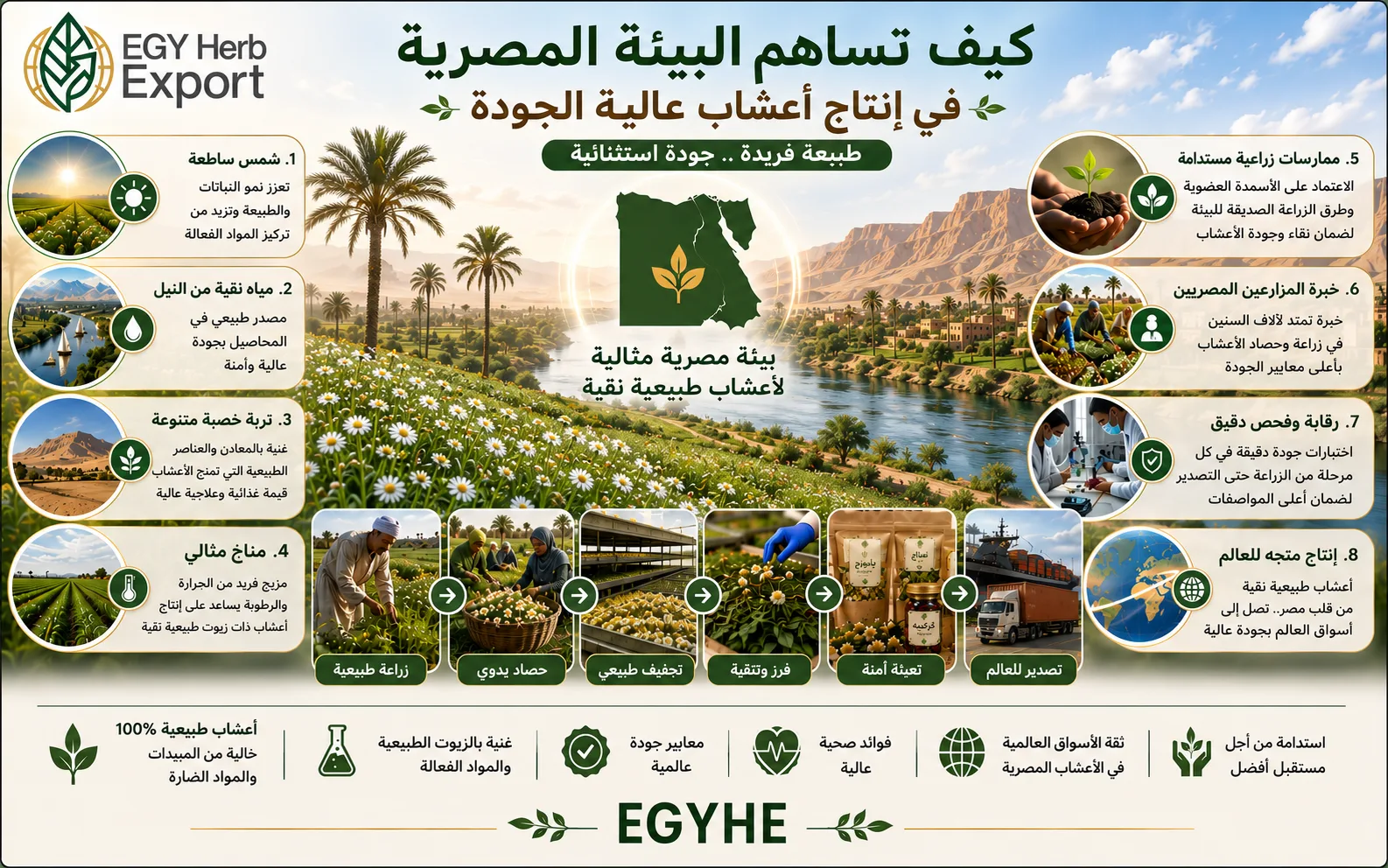
The answer is that the same plant species produces measurably different results depending on where it grows. Essential oil percentage, anthocyanin content, menthol concentration, color intensity — these are not fixed properties of a plant. They are outputs of the interaction between genetics, soil, climate, and farming practice. Egypt's environment produces specific outcomes in each of these categories that explain why Egyptian herbs consistently test at the higher end of quality ranges.
Sunlight Hours and What They Do to Aromatic Plants
Egypt receives between 3,200 and 3,500 hours of sunlight per year — one of the highest figures globally. For comparison, Germany (a major herb-importing country) receives approximately 1,600 hours. The Netherlands receives around 1,700.
This difference is not just agricultural trivia. Sunlight drives photosynthesis, which drives the production of secondary metabolites — the compounds that make herbs aromatic, medicinally active, and commercially valuable. Essential oils, flavonoids, and anthocyanins are all secondary metabolites. More sunlight exposure, particularly during the critical flowering and pre-harvest stage, directly increases their concentration in the plant.
This is why Egyptian chamomile consistently shows higher essential oil content than chamomile from more temperate origins, and why Egyptian hibiscus produces deeper red color grades — the anthocyanins responsible for color are synthesized in response to light exposure.
For buyers specifying minimum essential oil percentages or anthocyanin content in their purchase contracts, Egyptian origin is not a preference. It is a specification requirement.
Low Humidity and Natural Drying Advantages
Humidity during the growing season is one of the least-discussed factors in herb quality, but one of the most practically significant.
High ambient humidity during flowering increases the risk of fungal development on flower heads — particularly relevant for chamomile, which has a dense flower structure that retains moisture. Fungal contamination affects both the visual quality of the dried product and its microbial count, which is tested by EU food safety authorities.
Egypt's primary herb-growing regions — Fayoum, Beni Suef, Minya, and Upper Egypt — experience relative humidity levels of 30 to 50% during the main growing and harvest periods. This is significantly lower than herb-growing regions in Central Europe, the Balkans, or South and Southeast Asia.
The practical result: Egyptian herbs complete the drying process faster and with lower microbial risk. Moisture content targets below 12% — the standard EU requirement — are consistently achievable under Egyptian ambient conditions without mechanical intervention.
Temperature Variation: The Stress Factor That Increases Quality
Uniform warm temperatures are not actually ideal for aromatic herb cultivation. Research on essential oil-bearing plants consistently shows that thermal stress — specifically the variation between daytime highs and nighttime lows — increases the plant's production of protective secondary metabolites, including the essential oils that buyers are purchasing.
Upper Egypt regions like Aswan, Qena, and southern Fayoum experience day-night temperature differentials of 15 to 20 degrees Celsius during key growing months. This range is significantly wider than what Mediterranean or tropical herb origins provide.
The plant responds to cooler nights by concentrating its aromatic compounds — essentially a protective mechanism that produces exactly the quality outcome buyers want. Egyptian mint tested from Upper Egypt farms regularly shows menthol concentrations at the higher end of the Matricaria chamomilla specification range. Egyptian chamomile from Fayoum consistently outperforms lower-altitude origins on essential oil percentage.
Soil Composition in the Primary Growing Regions
The agricultural land in Fayoum, Beni Suef, and Minya sits on Nile alluvial deposits — mineral-rich silt carried from the Ethiopian Highlands over thousands of years. This soil is naturally high in calcium, magnesium, and trace minerals that support healthy plant development and contribute to essential oil profile complexity.
The shift to drip irrigation across many Egyptian herb farms over the past decade has reduced the salt accumulation that flood irrigation previously caused, improving soil health and reducing chemical inputs. This has had a direct positive effect on pesticide residue profiles — increasingly important as EU MRL regulations tighten.
Organic certification rates among Egyptian herb exporters have been rising consistently. Around 25% of Egyptian herb exports now carry EU Organic or USDA Organic certification, with this share increasing year on year as more farms complete the transition.
What This Means for Buyers Practically
The environmental factors described above are not theoretical. They show up in COA results, in pesticide residue panels, and in sensory evaluations.
Buyers who specify Egyptian origin for chamomile, hibiscus, or mint are not paying a premium for branding. They are purchasing the output of a specific combination of sunlight, humidity, temperature variation, and soil that no other origin fully replicates.
The practical checklist for buyers evaluating Egyptian herb suppliers:
Request COA data showing essential oil percentage and moisture content. Compare across at least two growing seasons to verify consistency. Ask for pesticide residue test results against EU MRL panel if shipping to European markets. Confirm harvest region — Fayoum chamomile and Aswan hibiscus are not interchangeable with delta-grown equivalents. For organic requirements, verify farm-level certification, not just product certification.
EGY Herb Export sources directly from certified farms in Fayoum, Beni Suef, and Minya, with full COA documentation and pesticide residue testing available for every shipment. Minimum order 500kg, FOB Cairo.
Request a quote or download our product catalog.